
 (excl. BMX)
Group riding: how to ride together and actually enjoy it
Group riding on electric skateboards: how to actually enjoy it, not just survive it
Riding with friends sounds simple until you actually try it. Someone's board runs out of charge an hour before everyone else's. Someone else keeps disappearing into the distance because their top speed is ten km/h higher than the rest of the group. What should be the best part of owning an electric skateboard, sharing it with people, often ends up being the part that causes the most friction.
The problem is rarely the people. It is almost always the mismatch between boards, and nobody planning for it in advance.
Different boards ride at different speeds, and that changes everything
An electric skateboard with a smaller battery and lower-power motors is not a worse board, but it does behave differently on a group ride than a board with dual high-output motors and a larger pack. A rider on a lighter, shorter-range setup might be working through eco mode just to keep the battery alive for the return trip, while a rider on a bigger board is cruising in sport mode without a second thought. Neither rider is doing anything wrong. They are just riding two different experiences at the same time.
This is the first thing worth sorting out before wheels even touch tarmac. Ask what everyone is riding, roughly what range they get in real conditions, and what speed feels comfortable rather than just possible. A group ride is only as enjoyable as its slowest, most anxious rider, and pretending otherwise just means someone spends the whole session stressed about their battery percentage instead of looking at the view.
Plan the route around the group, not the fastest rider
Hamilton's flat, wide streets are forgiving for mixed-ability groups because nobody is fighting gradient or trying to keep momentum through hills. Wellington is the opposite. Its hills are relentless, and a board with a lower hill-climb rating will work considerably harder there than one built for steep gradients, which affects both speed and battery drain far more than distance alone. If your group includes a mix of boards, Wellington's hillier routes will expose that mismatch quickly.
Auckland's waterfront paths and Christchurch's flat, wide cycleways sit somewhere in the middle. They are genuinely good group-riding terrain because they are forgiving on power and let riders of different experience levels hold a similar pace without anyone straining. Queenstown is a different conversation entirely. Its trails and undulating terrain reward all-terrain setups, and a group mixing street wheels with pneumatic tyres there will split apart almost immediately, because one setup is built for grip and rough surfaces and the other simply is not.
The point is not that any of these cities are off-limits. It is that route choice should follow from what your group is actually riding, not the other way around.
Spacing and signals matter more than people expect
Riding two abreast feels social, but it is also the fastest way to end up in an accident when a group needs to react to a car door, a pedestrian, or a pothole nobody saw coming. Staggered single file, with enough gap to react independently, is safer and it is also easier on newer riders who are still building confidence with braking distance and turning at speed.
A simple set of hand signals for slowing, stopping, and turning removes most of the guesswork. It sounds basic, but the majority of group riding mishaps come down to someone assuming the rider in front would signal a stop and they did not. Agree on it before you start moving, not halfway through the ride.
Charging stops are part of the ride, not an interruption to it
Groups that treat charging breaks as dead time tend to rush them, and rushing a charge defeats the purpose. Groups that treat them as part of the ride, a coffee stop, a chance to swap notes on how the board is handling, a moment to check tyre pressure on all-terrain wheels, tend to enjoy the whole session more.
This matters more in a group than it does riding solo, because someone will always need longer than expected, whether that is a battery running low faster than planned or a rider who just wants a break from concentrating. Building slack into the plan, rather than treating the ride as a fixed-time loop, takes the pressure off everyone.
The best riding groups are built on shared setups, not just shared enthusiasm
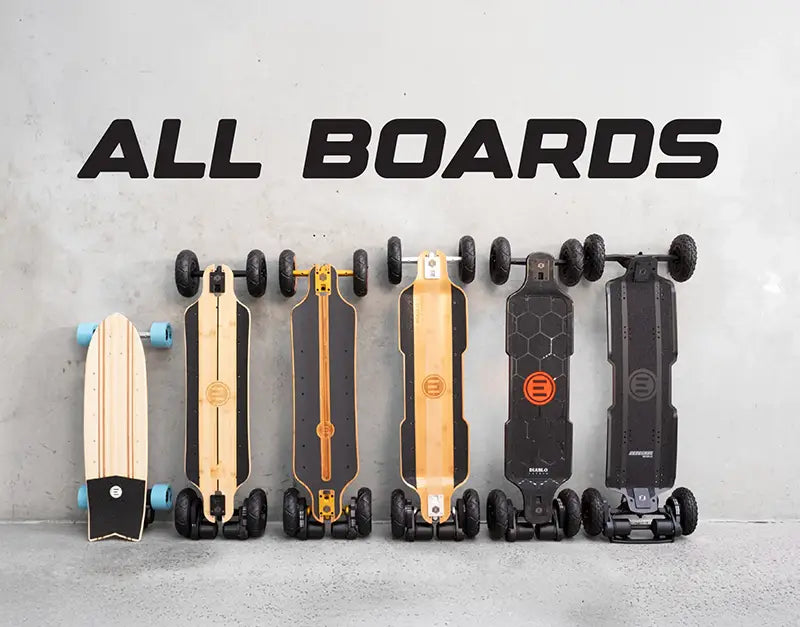
Some of the strongest local riding groups end up naturally gravitating toward similar equipment, not because they compare notes on gear obsessively, but because it removes the friction of mismatched speed and range. A group where everyone is riding boards with roughly similar battery capacity and similar terrain capability, whether that is a set of bamboo decks built for street riding or all-terrain setups suited to Queenstown's trails, simply rides better together. Nobody is waiting, nobody is anxious about getting home, and the conversation can actually be about the ride instead of logistics.
This is also where a lot of the genuine community around electric skateboarding comes from. It is less about owning the fastest board and more about finding people whose riding style and setup suit yours, then building routes and habits around that. New Zealand's riding scene is small enough that these groups tend to form around specific cities and specific terrain, Wellington's hill climbers, Christchurch's flat-path commuters, Queenstown's trail riders, and that specificity is part of what makes them work.
Riding with other people is one of the best reasons to own an electric skateboard, and it is also one of the easiest things to get wrong by accident. Sort out the pace, plan the route around the group rather than the fastest rider in it, agree on signals before you move, and stop treating charging breaks as an inconvenience. None of that requires better gear. It just requires actually thinking about the ride before you take it.
-
Posted in
electric skateboard, evolve
