
 (excl. BMX)
What people get wrong about electric skateboarding

What people get wrong about electric skateboarding
Most of the arguments against electric skateboarding fall apart the moment someone actually rides one properly set up for their needs. The scepticism is usually aimed at a version of the sport that does not really exist any more, built on assumptions that were true five years ago or were never true at all. If you are trying to work out whether an electric skateboard is worth it, it helps to clear away the misconceptions first.
The speed number is not the point
New riders searching for the best electric skateboard almost always start by comparing top speeds. It is an easy number to latch onto, but it tells you very little about what a board actually feels like to ride. A board that hits 50 km/h with a rigid carbon deck and wide trucks behaves nothing like a shorter board with the same claimed top speed and a softer, flexier setup.
What actually matters is how the power is delivered. A pair of 3000W motors in eco mode feels calm and predictable through Wellington's hills. The same motors in sport mode, with the throttle wound open, deliver a completely different ride. The speed figure on a spec sheet is a ceiling, not a description of how the board rides day to day. Riders who buy purely on the top number often end up with a board that is either more aggressive than they want or one they never push anywhere near its limit.
Range anxiety is mostly a first-week problem
People assume electric skateboards leave you stranded. In practice, range anxiety fades quickly once you understand your own riding pattern. Manufacturer range figures are based on flat ground, a lighter rider, and steady eco-mode throttle, so a board rated for 60 km on paper might realistically deliver 35 to 45 km for someone commuting through Hamilton's rolling suburbs or climbing out of Christchurch's flatter grid into the hills.
That is still a long way. Most commutes and weekend sessions sit well inside that real-world figure, and the habit of checking the app before a longer ride removes most of the guesswork. The anxiety is real for about a fortnight. After that, most riders know almost exactly what their board can do without thinking about it.
One board does not suit every surface
This is where a lot of first-time buyers get caught out. Street wheels are fast, efficient and responsive on sealed paths, but they are miserable on gravel, grass or broken footpaths. All-terrain tyres solve that problem by adding grip and comfort on rough ground, at the cost of some top speed and range, because the wider pneumatic tyres create more rolling resistance and draw more current from the motors.
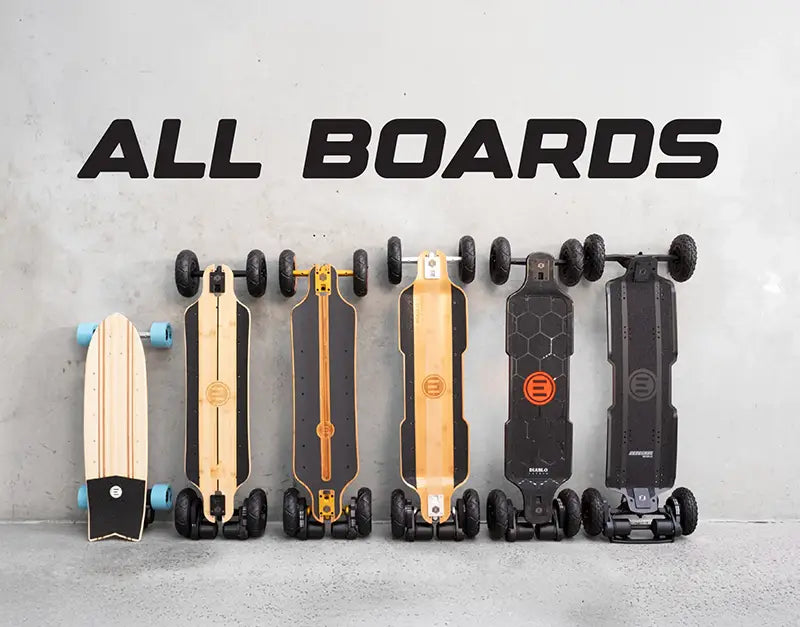
Auckland's waterfront paths and Wellington's sealed commuter routes are street wheel territory. Queenstown's mixed gravel trails and the rougher tracks around its lake paths are a different job entirely, and trying to do both on one wheel set means compromising on one end or the other. This is exactly why Evolve builds 2-in-1 configurations across its bamboo and carbon boards, so riders are not forced to choose a single surface and live with it.
Deck material changes more than people expect
Bamboo and carbon are often treated as a cosmetic choice, but the difference is mechanical. Bamboo decks flex naturally, absorbing vibration from rough tarmac and giving a smoother, more surf-like feel underfoot. It is a forgiving platform, and it is why bamboo boards tend to suit riders who are still building confidence with carving and braking.
Carbon decks are rigid by design. There is no flex to speak of, which means the board stays planted at higher speeds and on uneven surfaces, and it tends to be lighter for the same length. Riders who want maximum stability at speed, or who are heavier and need a platform that does not flex under load, generally get on better with carbon. Neither is the correct answer. They solve different problems.
The price comparison people make is the wrong one
A common objection to electric skateboards is that they cost more than a cheap electric scooter or a budget board from an unfamiliar brand. That comparison misses what you are actually paying for. Sensored brushless motors, a properly managed lithium battery with a real BMS, forged trucks and a controller tuned for smooth power delivery are the difference between a board that lasts years and one that fails within months.
Total cost of ownership is a more honest way to think about it. A board with proven components, spare parts availability and support behind it costs less over three years than replacing a cheaper board twice. This is also where warranty and after-sales support genuinely matter, because a battery issue or a failed controller on an unsupported board usually means buying a new one entirely.
Beginners do not need to start small
There is a persistent idea that new riders should start on something underpowered and work their way up. In practice, the more useful variable for beginners is tunability, not raw power. A board with proper eco, sport and custom modes lets a new rider keep the throttle gentle and predictable while they learn, then open it up gradually as their confidence grows. Buying underpowered just means an early upgrade once the training-wheels stage wears off.
What actually matters for a nervous first-time rider is stability. Wider trucks, sensible bushings and a deck that suits their weight do more for confidence than a deliberately weak motor ever will.
Maintenance is lighter than people expect, but it is not optional
People occasionally treat electric skateboards as appliances, expecting them to work indefinitely with zero attention. Bearings need cleaning, belts need checking, all-terrain tyres need to be kept at the right pressure, and batteries last longer when they are not left fully charged or completely flat for long periods. None of this is difficult, but skipping it is how good boards develop bad reputations.
Electric skateboarding is worth it for a lot of people, but not because the boards are magic. They are worth it because a well built board, matched properly to your terrain, your weight and your riding style, removes almost every complaint people have about the category. The boards that get bad reviews are usually the ones bought for the wrong job. Buy for your actual commute, your actual terrain and your actual confidence level, and most of the arguments against electric skateboarding simply stop applying to you.
-
Posted in
electric skateboard, evolve
